
Growth Investing vs Value Investing: What's the Difference and Which Works Better?
Growth investing and value investing are two of the most prominent strategies in the stock market. Both have produced legendary investors and multi-decade track records of outperformance. This guide explains what each strategy means and how they have performed over time.

On this page · 8 sections
Quick Answer: Growth investing focuses on companies expected to expand revenue and earnings significantly faster than average, typically at premium valuations. Value investing seeks companies trading below their intrinsic worth. Both strategies have produced legendary investors and decades of outperformance.
Key takeaways
- Value investors look for stocks trading below intrinsic value, often with low P/E and price-to-book ratios.
- Growth investors pay premium multiples for companies expected to grow much faster than the market.
- Neither style permanently dominates: growth led from 2010 to 2020, while value held up better when rates rose in 2022.
- Rising interest rates hit growth stocks hardest because more of their earnings sit far in the future.
- Buffett's shift to buying a wonderful company at a fair price blends both styles.
Two Philosophies, One Goal
Growth investors and value investors both want to earn market-beating returns over the long run. They just have very different ideas about how to achieve that goal.
At the simplest level: growth investors pay for the future, betting on companies expected to expand significantly. Value investors focus on the present, looking for companies trading below what they are worth today. In practice, the sharpest investors have learned that the distinction is somewhat artificial, and the best investments often combine elements of both.
What Is Value Investing?
Value investing was pioneered by Benjamin Graham, who taught at Columbia Business School and wrote the seminal texts Security Analysis (1934) and The Intelligent Investor (1949). Graham's most famous student was Warren Buffett.
The core premise of value investing is that the stock market is occasionally irrational. Stocks sometimes trade significantly below their true intrinsic value due to fear, overreaction to bad news, or simply lack of attention. By buying these undervalued stocks and waiting for the market to recognize their true worth, value investors earn outsized returns.
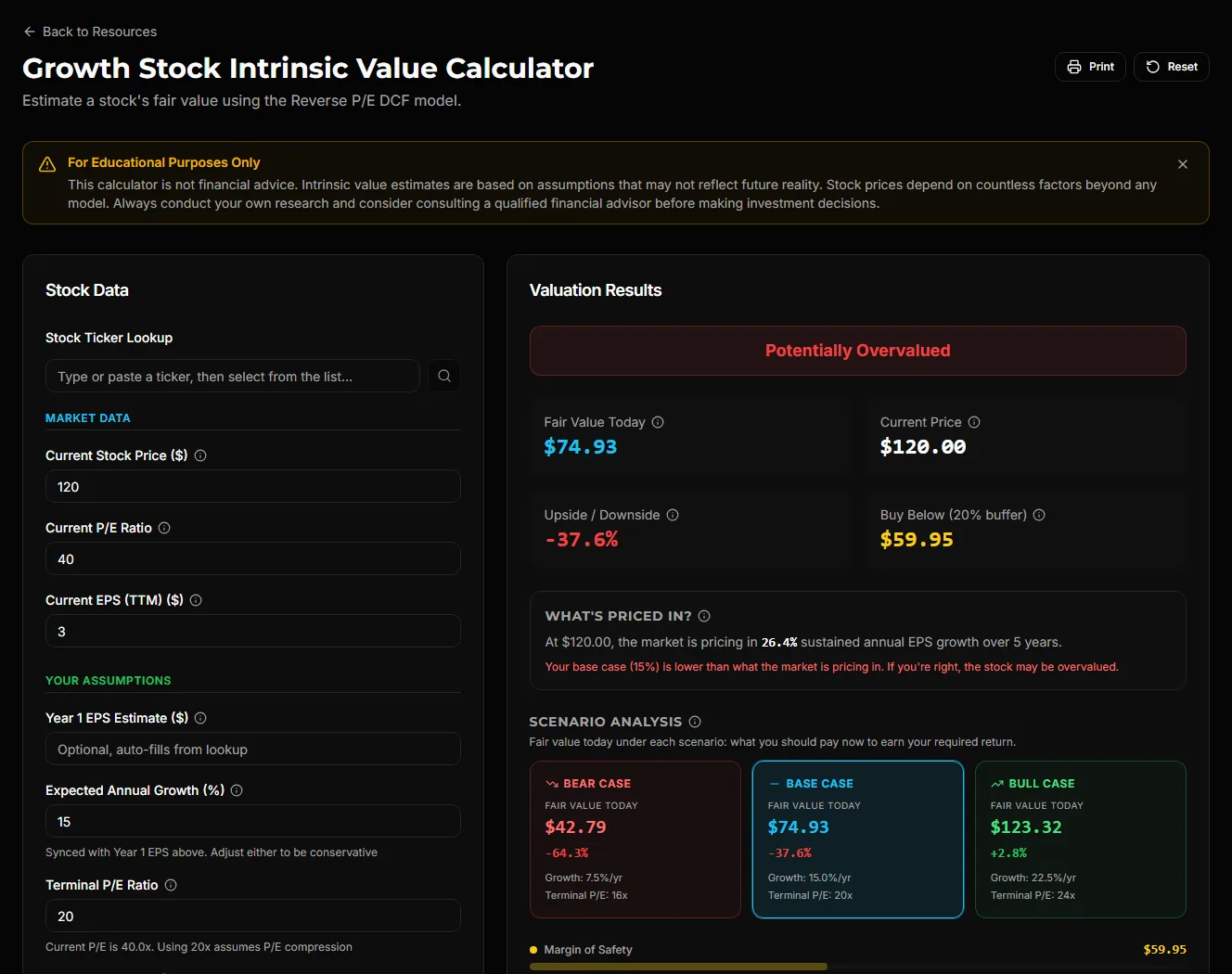
Graham developed the concept of the "margin of safety": only buy a stock if the price is significantly below your calculated intrinsic value. If you calculate a business is worth $100 per share, only buy at $70 or below. The 30% discount provides a buffer against errors in your analysis.
Classic value investing characteristics:
- Low P/E ratio relative to peers or historical average
- Low price-to-book ratio (stock trades near or below the value of net assets)
- High dividend yield (significant cash returned to shareholders)
- Stable, predictable businesses even if slow-growing
- Often neglected or unloved by the market
Real data · Compare
P/E ratio: TSLA, AAPL, KO, NVDA, JPM
Basis: trailing twelve months.
TSLA
Tesla
300.6x
AAPL
Apple
39.2x
KO
Coca-Cola
28.2x
NVDA
Nvidia
26.9x
JPM
JPMorgan
14.2x
P/E is share price divided by the last twelve months of earnings per share: how many dollars investors pay for $1 of profit.
What Is Growth Investing?
Growth investing focuses on companies expected to grow revenue, earnings, and market share significantly faster than the market average. Growth investors accept paying premium prices today for the right to participate in that exceptional future growth.
The logic is straightforward: if a company can compound earnings at 25% per year for ten years, the price you pay today becomes a small factor compared to the earnings power it will have in the future. The key is correctly identifying companies that can sustain high growth for long periods.
Growth investing characteristics:
- High P/E and P/S ratios relative to market averages (reflecting premium growth expectations)
- Revenue growth significantly above the market average, often 20%+ per year
- Expanding market opportunity (large addressable market)
- Often younger or earlier-stage companies in disrupting industries
- Usually reinvesting profits back into growth rather than paying dividends
Real data · NVDA
Nvidia revenue, last 5 fiscal years
Annual, USD. Latest fiscal year ended January 25, 2026.
$215.9B
+68.3% a year since FY2022
| Fiscal year | revenue |
|---|---|
| FY2022 | $26.9B |
| FY2023 | $27.0B |
| FY2024 | $60.9B |
| FY2025 | $130.5B |
| FY2026 | $215.9B |
Historical Performance
The question of which strategy has performed better over time is heavily debated and the answer is genuinely complicated by time period selection, definitions, and measurement methods.
The long-run research edge goes to value: Academic research by Fama and French published in the early 1990s demonstrated a "value premium," the finding that stocks with low price-to-book ratios historically outperformed high price-to-book stocks over very long periods. This became one of the most referenced findings in investment research.
But growth dominated from 2010 to 2020: The longest economic expansion in U.S. history, combined with historically low interest rates, created perfect conditions for growth stocks. Technology companies like Amazon, Apple, Netflix, and Alphabet delivered extraordinary returns that made value investing look broken by comparison. Many value fund managers underperformed their benchmarks badly during this decade.
Value recovered from 2021 to 2022: When interest rates rose sharply starting in 2022, growth stock valuations collapsed because rising rates reduce the present value of future earnings. Many high-flying growth stocks fell 50 to 80% from their peaks, while value stocks held up much better.
The honest answer: neither strategy permanently dominates. Both go through extended cycles of outperformance and underperformance. The "best" strategy depends heavily on the specific time period examined.
Buffett's Evolution: The Convergence
Warren Buffett started as a strict Graham-style value investor, buying cheap businesses regardless of quality. His investment style evolved significantly under the influence of his partner Charlie Munger.
Munger convinced Buffett that buying a wonderful company at a fair price is better than buying a fair company at a wonderful price. Buffett stopped looking for purely cheap businesses and started looking for high-quality businesses with durable competitive advantages, run by trustworthy management, at reasonable prices.
His purchase of Coca-Cola in 1988 exemplifies this evolution. Coca-Cola was not cheap by traditional value metrics at the time. But Buffett recognized an extraordinary brand, global distribution, pricing power, and a business model that could compound value for decades. His investment has returned hundreds of times his initial outlay.
This "quality at a fair price" approach is sometimes called GARP (Growth at a Reasonable Price) and represents the practical middle ground where most sophisticated investors operate today.
How Interest Rates Affect the Equation
The interest rate environment profoundly affects the relative performance of growth versus value investing, and understanding why helps explain recent history.
Growth stocks are valued on the basis of distant future earnings. When interest rates are low, the present value of future cash flows is higher (you are not discounting them as heavily). Low rates make those future earnings worth more today, supporting high growth stock valuations.
When interest rates rise, those future earnings are discounted more heavily, reducing their present value. Growth stocks with most of their earnings in the far future get hit hardest. Value stocks, with more of their earnings in the near term, are less affected.
This dynamic explains why 2022 was so painful for growth investors: rising from near zero to 5%+ interest rates applied a brutal discount to lofty growth stock valuations that had built up over a decade of low rates.
Which Should You Choose?
For most individual investors, the practical answer is not to choose rigidly. Instead:
- Focus on understanding the businesses you invest in
- Pay attention to price relative to value, not just absolute growth metrics
- Favor companies with durable competitive advantages regardless of category
- Consider diversifying across both value and growth characterizations
- Match your strategy to your temperament: can you hold a "cheap" company for three to five years while the market ignores it? Can you hold a high-multiple growth stock through a 50% drawdown?
The best investors in each style share a common trait: discipline and patience. Whether value or growth, the ability to maintain conviction through periods of underperformance, while rigorously checking your original analysis, separates great investors from average ones.
Frequently Asked Questions
What is the main difference between growth and value investing?
Growth investors pay premium prices for companies expected to grow significantly above the market average. They prioritize future earnings potential. Value investors seek companies trading below their intrinsic value, based on current assets and earnings. Growth investing focuses on where a company is going; value investing focuses on what a company is worth today.
Which investment strategy has better returns: growth or value?
Academic research shows value stocks have outperformed growth stocks over very long periods (the 'value premium'). However, from 2010 to 2020, growth stocks, particularly U.S. technology, dominated dramatically. From 2022 onward, rising interest rates hurt growth stock valuations significantly. Neither strategy consistently outperforms across all time periods and market conditions.
Why do interest rates affect growth stocks more than value stocks?
Growth stocks derive most of their value from earnings expected far in the future. When interest rates rise, future cash flows are discounted more heavily, reducing their present value. Value stocks have more of their earnings in the near term, making them less sensitive to rate changes. This is why growth stocks fell sharply in 2022 when the Fed raised rates aggressively.
What is GARP investing?
GARP stands for Growth at a Reasonable Price. It is a hybrid approach that seeks companies with solid growth prospects but without the extreme valuations associated with pure growth investing. Warren Buffett's evolved style, influenced by Charlie Munger, is often described as GARP: buying wonderful businesses at fair prices.
Can a stock be both a growth and value stock?
Yes. When a high-quality growth company temporarily trades at a discounted valuation, perhaps due to a market correction or short-term earnings miss, it can be attractive from both perspectives. This overlap is the sweet spot many investors look for: a business with strong growth characteristics at a valuation that provides a margin of safety.