
Revenue Growth Explained: What to Look for When Analyzing a Stock
Revenue growth is the starting point for almost every stock analysis. But not all revenue growth is equal. This guide explains what strong revenue growth looks like, how to evaluate it properly, and the warning signs that growth might not be as good as it appears.

On this page · 8 sections
Quick Answer: Revenue growth is the percentage increase in a company's sales from one period to the next. It is the most fundamental indicator that a business is expanding. Year-over-year revenue growth above 10% is considered strong for established companies; above 20% is considered high-growth territory.
Key takeaways
- Revenue growth is the most fundamental sign that a business is expanding.
- Above 10% a year is strong for established companies; above 20% is high-growth territory.
- Benchmark growth against direct competitors, not the broader market.
- Revenue quality matters: recurring, high-gross-margin, diversified revenue is worth more.
- Watch for decelerating growth and revenue growing faster than cash flow.
Why Revenue Growth Matters Above Almost Everything Else
A company's revenue is the top line, the starting point for everything else. Profits, cash flow, and earnings per share all derive from revenue. A business cannot grow profits faster than revenue indefinitely. Eventually, without more customers spending more money, the earnings engine stalls.
Revenue growth answers the most fundamental question in business analysis: is this company selling more over time? If the answer is yes, consistently, that is the foundation of a strong investment thesis. If the answer is no, everything else needs extra scrutiny.
How to Read Revenue Growth Numbers
Revenue growth is typically expressed as a year-over-year (YoY) percentage change, comparing the current period to the same period one year ago. You will often see quarterly figures compared to the same quarter the prior year, and annual figures compared to the prior full year.
A company that reported $100 million in revenue last year and $120 million this year has grown at 20% year-over-year.
When evaluating revenue growth, look at:
- The trend over multiple years, not just one period. Three to five years of data reveals whether growth is accelerating, decelerating, or volatile.
- Year-over-year comparisons alongside sequential (quarter-over-quarter) trends for a fuller picture
- Revenue growth relative to competitors in the same industry
- Organic growth vs. acquisition-driven growth. Growing by acquiring other companies is very different from growing by winning more customers.
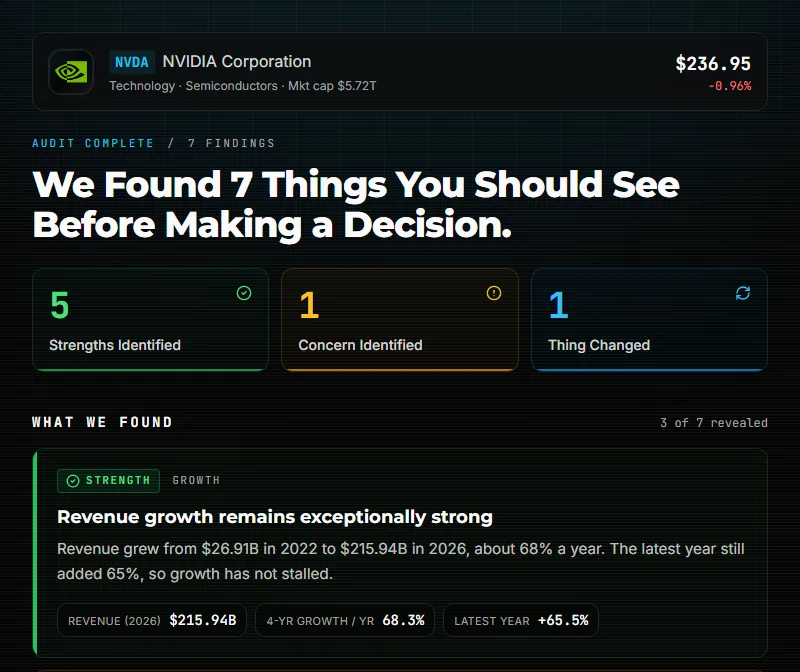
Real data · NVDA
Nvidia revenue, last 5 fiscal years
Annual, USD. Latest fiscal year ended January 25, 2026.
$215.9B
+68.3% a year since FY2022
| Fiscal year | revenue |
|---|---|
| FY2022 | $26.9B |
| FY2023 | $27.0B |
| FY2024 | $60.9B |
| FY2025 | $130.5B |
| FY2026 | $215.9B |
What Counts as Strong Revenue Growth by Industry
Expectations vary significantly by sector. There is no universal "good" revenue growth rate.
Technology and software: High-growth SaaS companies often target 20 to 40% annual revenue growth in their early years. When a company's growth rate drops below 20% in this sector, it often gets repriced downward significantly by the market.
Consumer staples and utilities: These stable, mature businesses might grow revenue at 2 to 5% per year, roughly in line with inflation and population growth. That is perfectly acceptable for their business models.
Healthcare: Pharmaceutical and biotech companies can show massive revenue swings based on drug approvals and patent cliffs. Medical device companies often target 8 to 15% annual growth.
Financial services: Banks and insurers typically grow revenue at 5 to 10% per year in normal environments, with significant sensitivity to interest rate cycles.
Always benchmark revenue growth against direct competitors, not the broader market.
Real data · KO
Coca-Cola revenue, last 5 fiscal years
Annual, USD. Latest fiscal year ended December 31, 2025.
$47.9B
+5.5% a year since FY2021
| Fiscal year | revenue |
|---|---|
| FY2021 | $38.7B |
| FY2022 | $43.0B |
| FY2023 | $45.8B |
| FY2024 | $47.1B |
| FY2025 | $47.9B |
Revenue Quality: Not All Revenue Is Created Equal
High revenue growth numbers do not automatically mean a company is thriving. Revenue quality matters enormously.
Recurring revenue is more valuable than one-time revenue. A software company with 90% recurring subscription revenue is far more predictable and valuable than a hardware company that must re-win every customer every year.
Gross margin matters. Revenue growing at 30% is exciting. Revenue growing at 30% but with gross margins of 20% is far less exciting than revenue growing at 30% with gross margins of 75%. High-gross-margin revenue leaves much more room for reinvestment and profit.
Revenue concentration is a risk factor. If one customer accounts for 40% of revenue, losing that customer is catastrophic. Diversified revenue across many customers is more durable.
Geographic and product diversification reduce risk. A company with revenue across many geographies and product lines is less vulnerable than one dependent on a single region or product.
Warning Signs in Revenue Growth
Be cautious when you see any of the following alongside revenue growth figures:
Decelerating growth rate: A company growing at 50%, then 35%, then 22%, then 15% is slowing significantly. The stock market often prices growth stocks based on the expectation of continued high growth. When growth decelerates, even if revenue is still rising, the stock can fall sharply because the future looks less exciting than it once did.
Revenue growing faster than cash flow: If revenue is growing 30% but operating cash flow is flat or declining, the company may be buying revenue through heavy discounting, lenient payment terms, or unsustainable promotions.
Accounts receivable growing faster than revenue: If money owed to the company is growing faster than sales, customers may be paying more slowly. This can be a sign of revenue being booked before it is truly earned.
One-time items inflating revenue: Companies sometimes book non-recurring revenue from asset sales, settlements, or government contracts. Strip these out when evaluating core business growth.
Acquisition-driven growth without organic growth: Companies that grow only by buying other businesses are papering over a lack of organic momentum. Look for companies that show strong organic growth in addition to any acquisitions.
Compound Annual Growth Rate (CAGR)
When evaluating revenue growth over multiple years, the compound annual growth rate (CAGR) is a useful summary metric. It tells you the smoothed average annual growth rate over a period, regardless of volatility in individual years.
A company that grew revenue from $100 million to $215 million over five years has a CAGR of approximately 16.5% per year. This is more informative than saying revenue grew 115% over five years, because it accounts for the compounding effect.
CAGR is especially useful for comparing companies that started at different revenue bases. A company growing from $1 billion to $2 billion over five years (14.9% CAGR) and one growing from $10 million to $20 million (14.9% CAGR) had the same percentage growth rate, even though the absolute dollar amounts are very different.
Putting Revenue Growth in Context
Revenue growth is an essential input but it is not sufficient on its own. The best investments are companies that combine strong revenue growth with improving profit margins, growing free cash flow, and durable competitive advantages.
A company growing revenue at 40% annually but burning through cash with no path to profitability carries significant risk. A company growing at 15% but generating strong free cash flow with expanding margins can compound shareholder value for decades.
The ChartEquity Stock Audit evaluates revenue growth as one of six modules in a comprehensive framework. Strong, consistent, accelerating revenue growth earns the highest scores. Slowing or erratic growth earns lower marks, regardless of the absolute growth rate.
Frequently Asked Questions
What is a good revenue growth rate for a stock?
A good revenue growth rate depends on the industry and company stage. For mature large-cap companies, 5 to 10% annual growth is solid. High-growth technology companies typically target 20 to 40% per year. Declining revenue is generally a red flag unless the company is deliberately shedding low-margin customers.
How do you calculate year-over-year revenue growth?
Subtract last year's revenue from this year's revenue, then divide by last year's revenue and multiply by 100 to get the percentage. For example: if revenue grew from $100 million to $120 million, growth is ($120M - $100M) / $100M x 100 = 20% year-over-year growth.
What is organic revenue growth vs inorganic growth?
Organic growth comes from winning new customers, raising prices, or expanding existing relationships with current customers. Inorganic growth comes from acquiring other businesses. Organic growth is generally considered higher quality because it demonstrates the core business is expanding on its own merits without requiring acquisitions.
Why is revenue growth important for investors?
Revenue growth is the top-line engine for all other financial metrics. Without growing revenue, it becomes increasingly difficult to grow profits, earnings per share, and free cash flow over time. Consistent revenue growth also signals that customers value the company's products or services and are choosing them over competitors.
What does decelerating revenue growth signal?
Decelerating growth, where the growth rate slows each quarter or year, can signal market saturation, increased competition, product cycle maturity, or macroeconomic headwinds. For high-growth companies with premium valuations, even a slowdown from 40% to 25% growth can trigger significant stock price declines as expectations reset.